
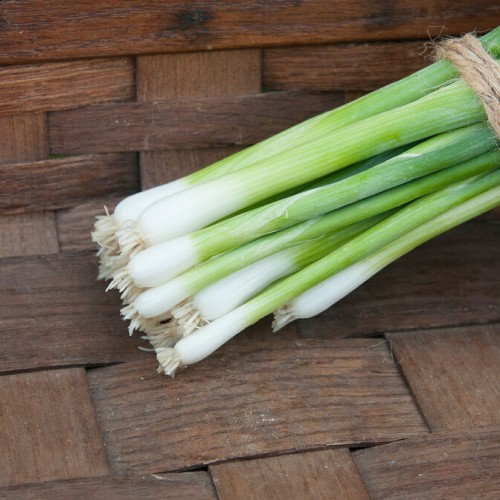
Description
SCIENTIFIC NAME:
Allium fistulosum
CULTURE:
Seed can be sown in early spring for summer use, and in July or August for fall and spring use. Bunching onions prefer a soil with a pH of 6.2–6.8. Extra-hardy varieties will normally survive the winter if the soil is well drained.
DIRECT SEEDING:
Sow 0,6 cm apart in rows of 5-7,5 cm wide bands, 0,6-1,2 cm deep. Thin to about an inch apart only if large diameter is needed. Keep well cultivated so that plants receive maximum light.
TRANSPLANTING:
Sow 6–8 seeds per cell in 72-cell trays at the same time you would seed bulbing onions for transplant. Transplant seedling clusters 15-20 cm apart in rows 45 cm apart. For negi-style scallions with a thicker blanched portion, start in flats. Then, beginning in late spring, when 20-45 cm tall and pencil-thick, transplant outdoors 15 cm apart, rows 60 cm apart in holes dibbled about 15 cm deep. Only 2,5-5 cm of leaves need extend above the soil surface. Do not firm soil — allow irrigation or rain to fill in the dibble hole.
BLANCHING:
During the growing period hill the plants with soil 2 or 3 times, higher with each hoeing. This forces the leaves higher up the plant resulting in extra-long blanched stalks and a much greater edible portion. When using the “dibble method”, hilling is reduced or eliminated.
HARVEST:
Loosen with fork or underminer and gather. Wash, hydrocool, and hold at near freezing until shipped or displayed.




Reviews
There are no reviews yet.